Booking supplier invoices
A supplier invoice (prejeti račun) is your supplier’s document, and it creates a payable. In VegaERP you first enter or upload it as a Osnutek (draft), then post it with a single button. This page covers both intake routes and the one step that actually puts the invoice into your books.
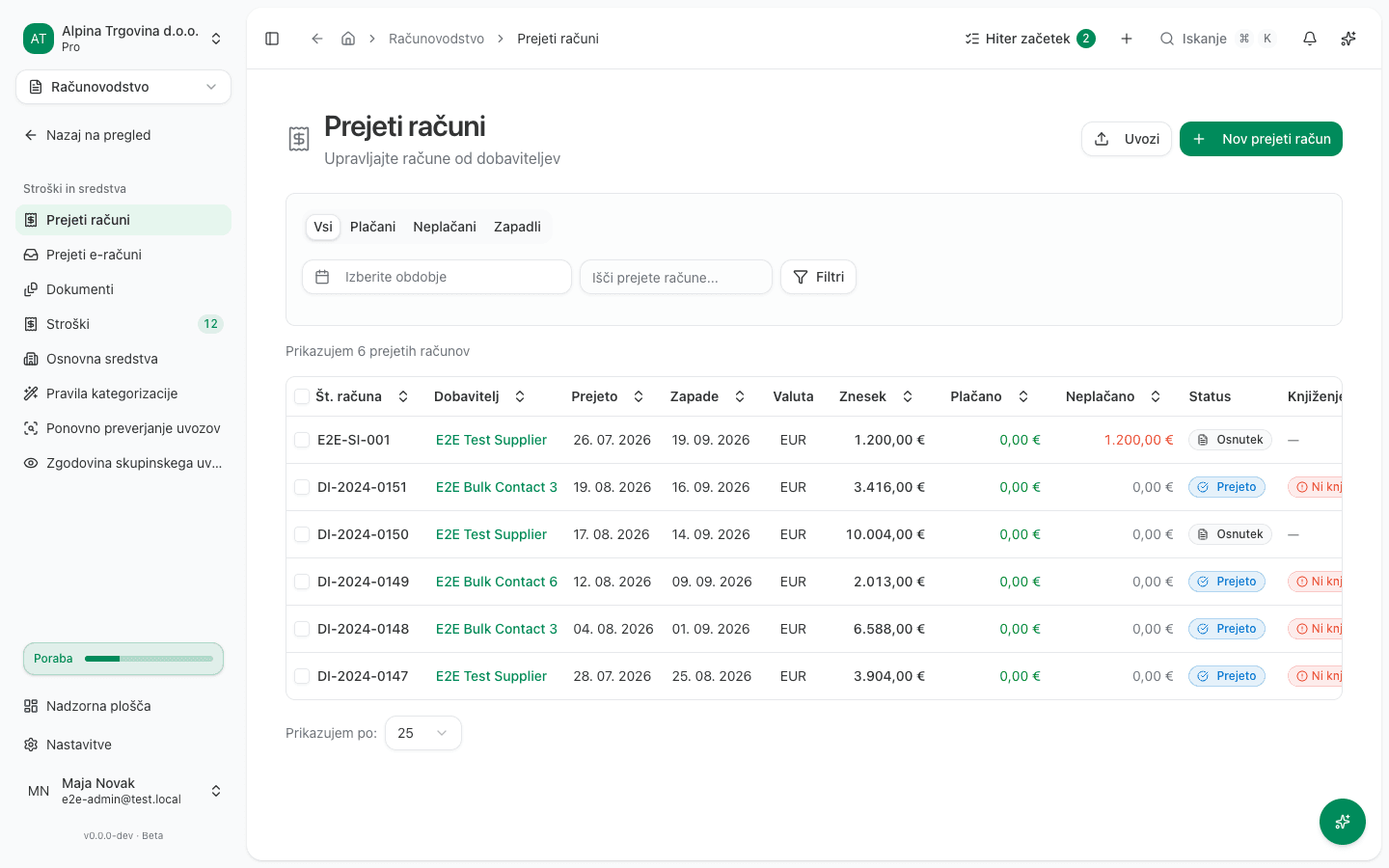
Open them from the left menu: Računovodstvo → Stroški in sredstva → Prejeti računi (Accounting → Costs and assets → Supplier invoices).
Supplier invoice or expense?
The same Stroški in sredstva group holds two different modules:
- Prejeti računi: a supplier’s document with its own invoice number, a payable and VAT.
- Stroški (Expenses): a simpler cost record with an approval flow and no line items.
The rule: anything carrying an invoice number from the supplier’s document belongs in Prejeti računi.
Entering an invoice by hand
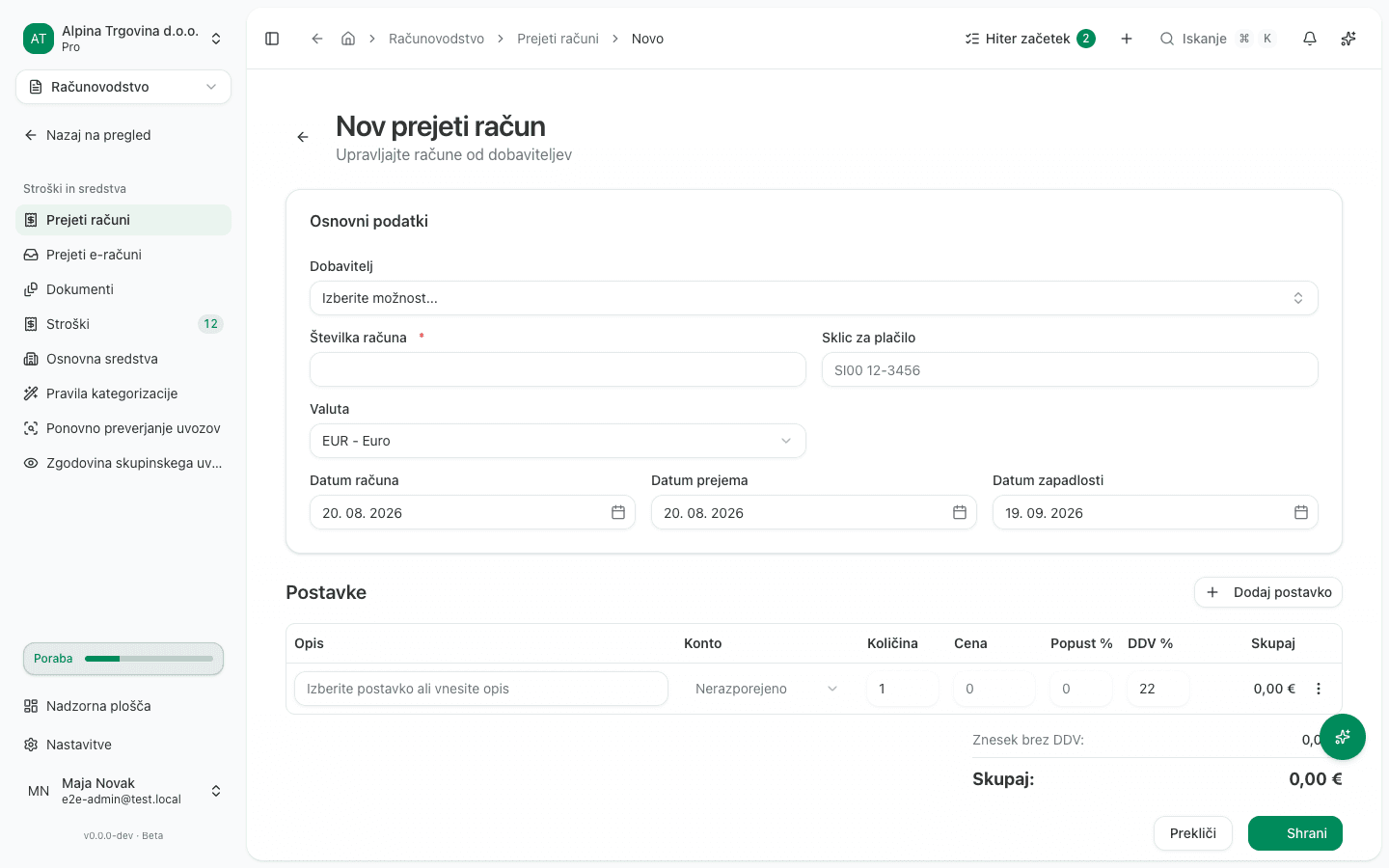
- On the Prejeti računi list, click Nov prejeti račun (New supplier invoice) at the top right.
- Under Dobavitelj (Supplier), pick an existing contact. If there isn’t one yet, add it under partners first. The form only selects among existing contacts.
- Fill in Številka računa (Invoice number). It is marked with an asterisk and is mandatory. Copy the number from the supplier’s document, not your own.
- Optionally complete Sklic za plačilo (Payment reference) and Valuta (Currency,
EUR - Euroby default). - Check the three dates, which are pre-filled: Datum računa (invoice date), Datum prejema (date received) and Datum zapadlosti (due date). Each opens with the Izberite datum button.
- Under Postavke (Line items), fill in a row (Opis, Količina, Cena, Popust %, DDV %); add more with Dodaj postavko. Skupaj and Povzetek recalculate as you type. Under Konto (account), pick the account the cost is booked to. A row left at Nerazporejeno (unassigned) is booked to 4100 Stroški storitev. You can pick or change the account later with Uredi (Edit), as long as the invoice is not booked yet.
- In Znesek z računa (total on the document), type the total due exactly as the document prints it. Prices on a receipt often include VAT, so the rounded lines can come to a cent or two less or more than the printed total. The printed total is then booked, and the line prices and the VAT stay as you entered them. If the difference is larger than rounding, the form tells you which two amounts disagree, and booking stops until you correct the lines or accept the difference. If the lines carry different VAT rates, the rounding cannot go to the base: after saving, open Uredi (Edit) and enter it in Dodatek (izven osnove za DDV) (adjustment outside the VAT base). Only rounding belongs there, never a larger difference. Do not change a line price to make the total match.
- Click Shrani (Save).
A foreign supplier’s invoice without VAT (self-assessment)
A supplier in another EU country bills you a service or goods without VAT, and you account for the VAT yourself. Enter such an invoice like this:
- In the line row, under Vrsta (Type), choose Storitev (Service) or Blago (Goods). It decides which VAT return field the amount reaches.
- Tick Obrnjeni DDV (Reverse VAT). The self-assessed rate appears beside it, taken from DDV % by default.
- Click Shrani (Save). Skupaj stays the amount without VAT that you owe the supplier.
On booking, both VAT amounts are posted at once, input and output, so the net VAT effect is nil. If you type a VAT rate for a supplier recorded abroad without ticking Obrnjeni DDV, the invoice is not saved: that VAT is not deductible in Slovenia. If the supplier charged its own country’s VAT, enter the line at 0 % with that VAT included in the price, so the total still matches the document. If the supplier is identified for VAT in Slovenia, record its Slovenian VAT number (SI…) on the contact card.
What success looks like
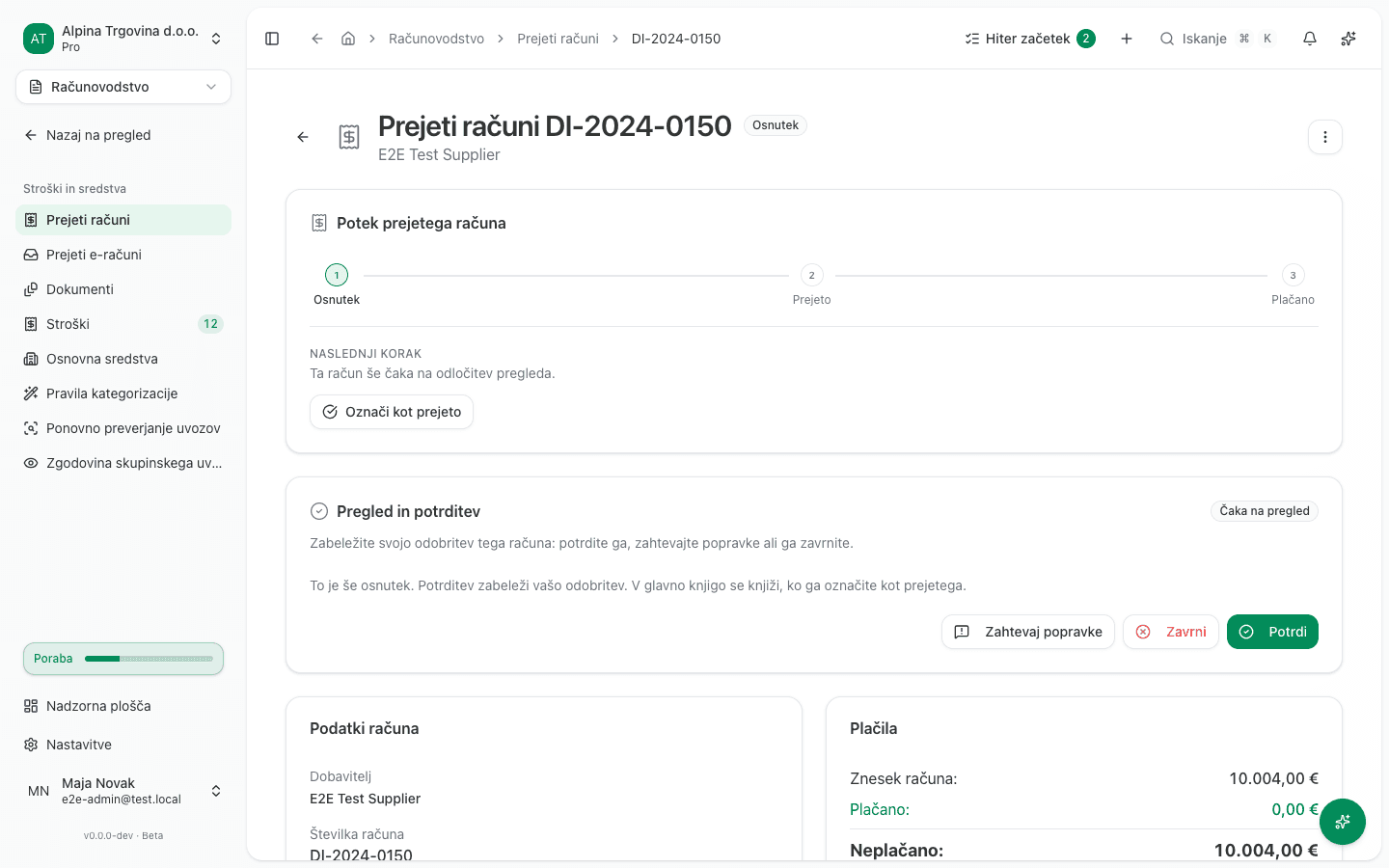
The invoice opens with status Osnutek. Potek prejetega računa at the top of the page shows three steps: Osnutek → Prejeto → Plačano, with the first marked as current. Below them, NASLEDNJI KORAK (Next step) reads “Ta račun je osnutek in še ni knjižen. Preverite podatke ob dokumentu, nato ga knjižite v glavno knjigo in knjigo DDV. Plačilo lahko zabeležite šele po knjiženju.” (This invoice is a draft and not booked yet. Check it against the document, then book it to the general ledger and the VAT books. A payment can be recorded only after booking.)
Uploading files (one or many)
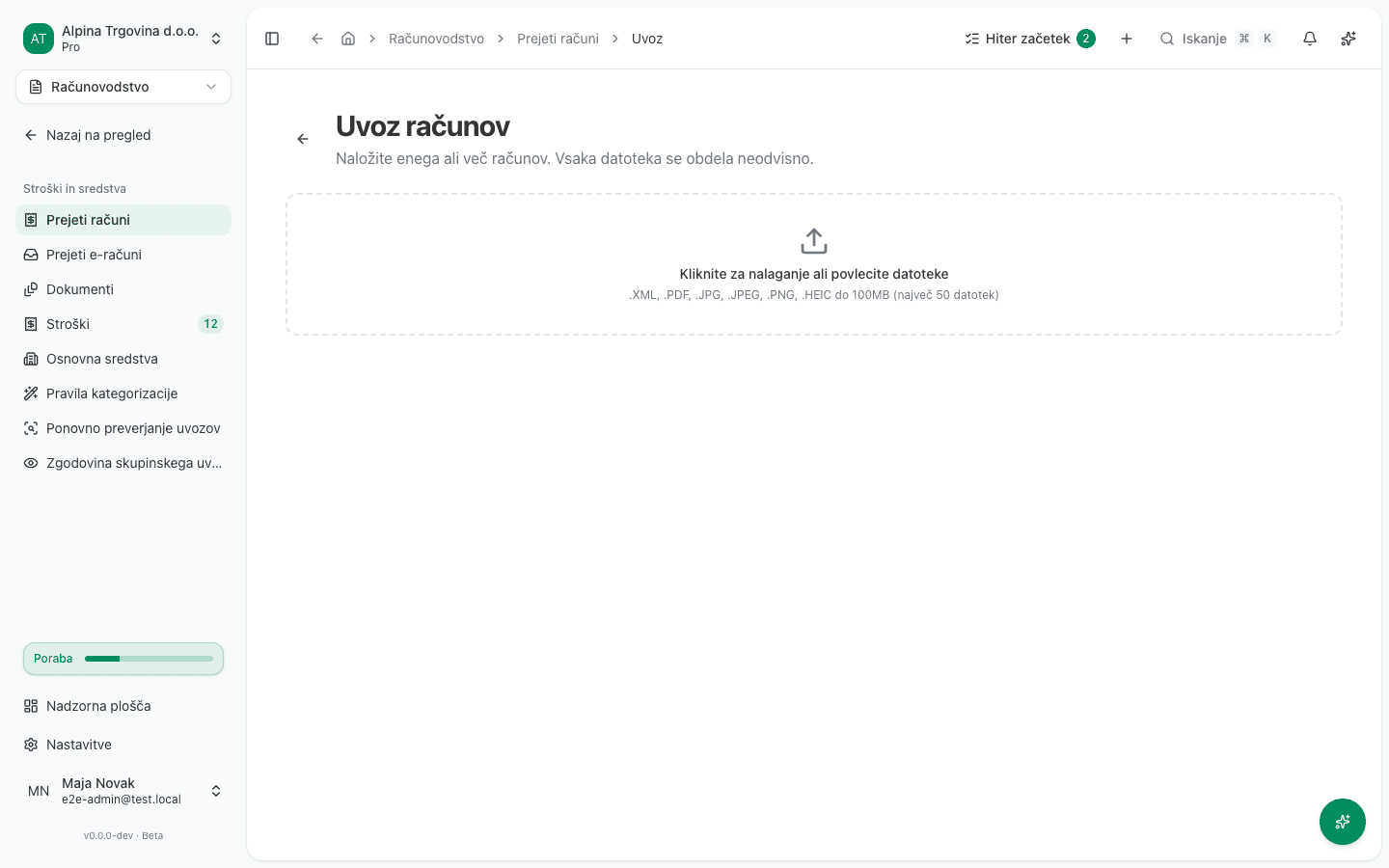
- On the Prejeti računi list, click Uvozi (Import).
- On the Uvoz računov page, click the Kliknite za nalaganje ali povlecite datoteke drop zone and choose your documents. The accepted formats are printed underneath: .XML, .PDF, .JPG, .JPEG, .PNG, .HEIC do 25MB (največ 50 datotek) (up to 25 MB per file, 50 files at a time).
- Each file is processed independently, as the page itself says: “Naložite enega ali več računov. Vsaka datoteka se obdela neodvisno.” One failure therefore doesn’t stop the rest.
- Click a file to open the review panel: the original document on the left, the extracted form on the right. The supplier field always shows a picker. When the document’s supplier is already one of your contacts it is selected for you, and the file reads Pripravljeno (Ready). Otherwise pick the right partner from your contacts, or click Dodaj novega partnerja (Add new partner) to create one from what the document printed. A file cannot be imported until a partner is linked this way, even if its other fields read correctly. Use Naslednja datoteka (Next file) in the panel’s footer to move to the next one without closing it.
- Click Uvozi (Import) on a file, or the import-all-ready button for all of them.
Uploading images and PDFs consumes AI credit; XML is parsed without it.
Importing books nothing. Every imported invoice is saved as an Osnutek (draft) with its extracted figures, the attached document and the supplier. It reaches the general ledger and the VAT books only once you check and book it (below). The import summary says so and offers an Odpri osnutke (Open drafts) link.
The same applies to the bulk Uvoz iz računov (Smart Import) and to a supplier invoice created from a purchase order: received invoices and received credit notes are saved as drafts, and you book them yourself. If a re-import hits an invoice that is already booked and would change its amounts, the import leaves it unchanged. Correct it on the invoice itself.
Review and approval (only when someone else reviews)
The Pregled in potrditev (Review and approve) card appears only when there is a second party to review: an accounting firm manages your company, or an administrator switched on Zahtevaj potrditev drugega uporabnika (Require a second person’s approval) under Nastavitve, Potrjevanje računov. If you keep the books alone you do not see it; booking the invoice is the decision. The number of users in the account does not change that.
The detail page is split in two. On the left is Izvorni dokument (the source document). It stays visible at every status. Beside it on the right is (when shown) the Pregled in potrditev card with three actions: Potrdi (Approve), Zahtevaj popravke (Request changes) and Zavrni (Reject), and under it the record itself: Podatki računa (invoice data) and Plačila (payments). Check the amounts in Podatki računa next to the document, and in Postavke (line items) below it.
An invoice with no linked document, one keyed in by hand for instance, has no document column; Podatki računa and Plačila sit side by side instead.
Approval is not posting. The app says so itself, right above the buttons:
To je še osnutek. Potrditev zabeleži vašo odobritev. V glavno knjigo in knjigo DDV se račun knjiži z gumbom »Preveri in knjiži«.
(This is still a draft. Approving records your sign-off. The invoice is booked to the general ledger and the VAT books with the “Preveri in knjiži” button.)
While the invoice is a draft waiting for a review decision, NASLEDNJI KORAK reads Ta račun še čaka na odločitev pregleda. (This invoice is still waiting for a review decision.) The Preveri in knjiži button is still there. A pending review does not lock the step; it only means the emphasised action on the page is Potrdi. Once the invoice is booked, that sentence is gone from NASLEDNJI KORAK, which now offers Zabeleži plačilo; a review still outstanding shows as the Čaka na pregled badge on the Pregled in potrditev card.
Booking: Preveri in knjiži
This step, and only this step, puts the invoice into the general ledger and the VAT books. It is the same for an invoice keyed in by hand and one that was imported.
- Open an invoice in status Osnutek and check it against the source document.
- Under NASLEDNJI KORAK, click Preveri in knjiži (Check and book).
- A dialog says what will happen: the cost, the payable and the input VAT are posted to the general ledger, the invoice enters the VAT books, and it books at the document’s own dates, not today’s. Click Knjiži (Book).
A received invoice that is not in the ledger yet
An invoice in Prejeto (Received) status that automatic posting has not written to the general ledger yet shows Knjiži (Post) under NASLEDNJI KORAK (Next step) as the highlighted action, with Zabeleži plačilo (Record payment) after it. Clicking Knjiži posts the invoice. If automatic posting failed, post it again with the button in the warning at the top of the page. While the invoice waits for a review decision, Potrdi (Approve) is the highlighted action and Knjiži stays available beside it.
Several invoices at once
On the Prejeti računi list, select rows and click Knjiži izbrane (Book selected). Only the selected drafts are booked. If one cannot be booked (its date falls in a closed period, for example), the rest are still booked and the notice says why each failed one was refused.
What success looks like
The status changes from Osnutek to Prejeto, the Prejeto step becomes current, and a journal entry is created described as Prejeti račun {number}. The Plačilo lahko zabeležite, ko je račun knjižen hint next to Plačila disappears, and only now can you record a payment.
If the invoice’s amounts do not reconcile (the header VAT differs from the VAT on the lines, the lines do not add up to the total, or the printed total differs), booking is refused and the message says which amount disagrees with which, and by how much. Correct the lines with Uredi (Edit). If the document prints an amount after VAT, outside its base (a pass-through, a reserve-fund amount, a rounding line), enter it in Dodatek (izven osnove za DDV) (Adjustment outside the VAT base), and in Vrsta dodatka (Adjustment type) choose what it is: Rezervni sklad (007) for a building manager’s use of the reserve fund, otherwise Prehodna postavka ali zaokrožitev (1400). Never change the document’s total to make it fit.
If the source document is not classified as an invoice (for example as a payment reminder, a delivery note or a contract), the system does not book it on its own. With Knjiži izbrane the notice for that invoice says how the document is classified. On the invoice’s own page a window opens where you confirm that it is an invoice after all and click Knjiži kot račun (Book as an invoice). Your answer replaces the document’s classification. If the document is not an invoice, close the window and delete the draft.
If the invoice’s date falls in a closed or locked period, booking is refused: the invoice stays a draft and the notice names the closed period. See Why can’t I post to this period?
Forgotten drafts
A draft is in no VAT book. So the DDV-O return for a period that still has draft supplier invoices says how many there are and offers an Odpri osnutke (Open drafts) link, and so does the period close. Check and book them before filing, or their input VAT is left out.
If posting fails, you get a Samodejna temeljnica ni uspela (Automatic journal entry failed) warning with a Ponovi (Retry) button instead. The usual causes are a closed accounting period or a missing account in the chart of accounts.
Payment
A payment can only be recorded after booking (Preveri in knjiži). A draft has no posted payable to settle. On an invoice in status Prejeto you get Zabeleži plačilo (Record payment), Plačilni nalog UPN (UPN payment slip) and, by selecting several rows in the list, Pripravi SEPA plačila (Prepare SEPA payments).
Common issues
- “Invoice number” is mandatory even on an uploaded document. If the AI didn’t read it off the scan, type it in. The import cannot complete without it.
- An invoice with that number already exists. The same number for the same supplier is blocked. During import this shows up as a duplicate and the file is skipped. Open the existing record instead of creating a second one.
- The import skipped a file that wasn’t actually a duplicate. If an invoice for the same supplier with the same amount and date already exists, the document is treated as a likely duplicate (a purchase receipt for an already-booked invoice, for example).
- A payment can’t be recorded. The invoice is still a Osnutek. Book it with Preveri in knjiži first.
- Paying via SEPA says there is no bank account on record for the supplier. The app never guesses where money should go. Open the partner (Stranke in dobavitelji) and enter their IBAN from the invoice in the Transakcijski račun (IBAN) field, then build the payment file again. If an IBAN is already there but the app reports it as invalid, correct it on the partner. The payment will deliberately not be redirected to some other account. Every other invoice in the batch still exports; the skipped ones are listed on the payment-file screen.
- “Preveri in knjiži” does nothing. Only drafts can be booked, so the invoice is already booked or cancelled.
- A subscription’s self-assessed VAT lands in the wrong VAT return month. The VAT is due
when the subscription period ends. Foreign providers often print the period as
Sep 1 – Oct 1, which means September; on import from a foreign supplier the app records that end as 30 September and says so in a warning. On the invoice’s edit page, check Konec obdobja opravljene storitve (Service period end): it must be the last day the period covers. On a paid invoice you can correct the end but not Začetek obdobja opravljene storitve (Service period start), because that is the date it is booked on. If the return for that month is already filed, the app refuses the change; the remedy is then a correction of the return.
A posted invoice can’t be deleted. Izbriši still appears in the Več menu on a posted invoice, but the app only refuses once you confirm the deletion: a Ta račun je že vknjižen (“This invoice is already posted”) dialog explains that deleting it would leave the general ledger out of balance, and offers Storniraj račun (Reverse the invoice) instead. The reversal sets the status to reversed and records the opposite entry, so your books stay balanced. In the supplier-invoice list, a posted invoice’s row menu offers Storniraj račun directly instead of deleting; if the app does not know yet that the row is posted, confirming the deletion opens the same dialog right there in the list. The same rule for outgoing invoices is covered in Fixing an invoice you already issued.
The amounts on a paid or cancelled invoice can no longer be corrected. Its posting is final; the correction is made with a separate document.