Invoicing & e-Račun
VegaERP handles both regular PDF invoicing and electronic B2B invoicing (e-Račun) for customers that require it.
Issuing an invoice
- In the left sidebar, go to Računovodstvo → Fakturiranje → Računi (“Accounting → Invoicing → Invoices”).
- Click Dodaj račun (“Add invoice”) in the top right.
- Under Stranka (“Customer”), pick the contact you’re invoicing — the system uses their VAT-payer status and country to apply the correct VAT treatment automatically. Set Izdano (issue date) and Rok plačila (payment due date); both default sensibly but can be changed.
- Under Postavke (“Line items”), click Dodaj postavko (“Add item”) for each line. For every item, fill in Opis (description), Vrsta (Blago/Storitev — goods/service), Količina (quantity), Cena (unit price), and DDV % (VAT rate). Check Obrnjeni DDV (“Reverse charge”) only for the specific cross-border B2B cases where reverse charge applies — see VAT books & the DDV-O form.
- Click Shrani (“Save”). The invoice is created as a Osnutek (“Draft”) — nothing is booked or sent yet.
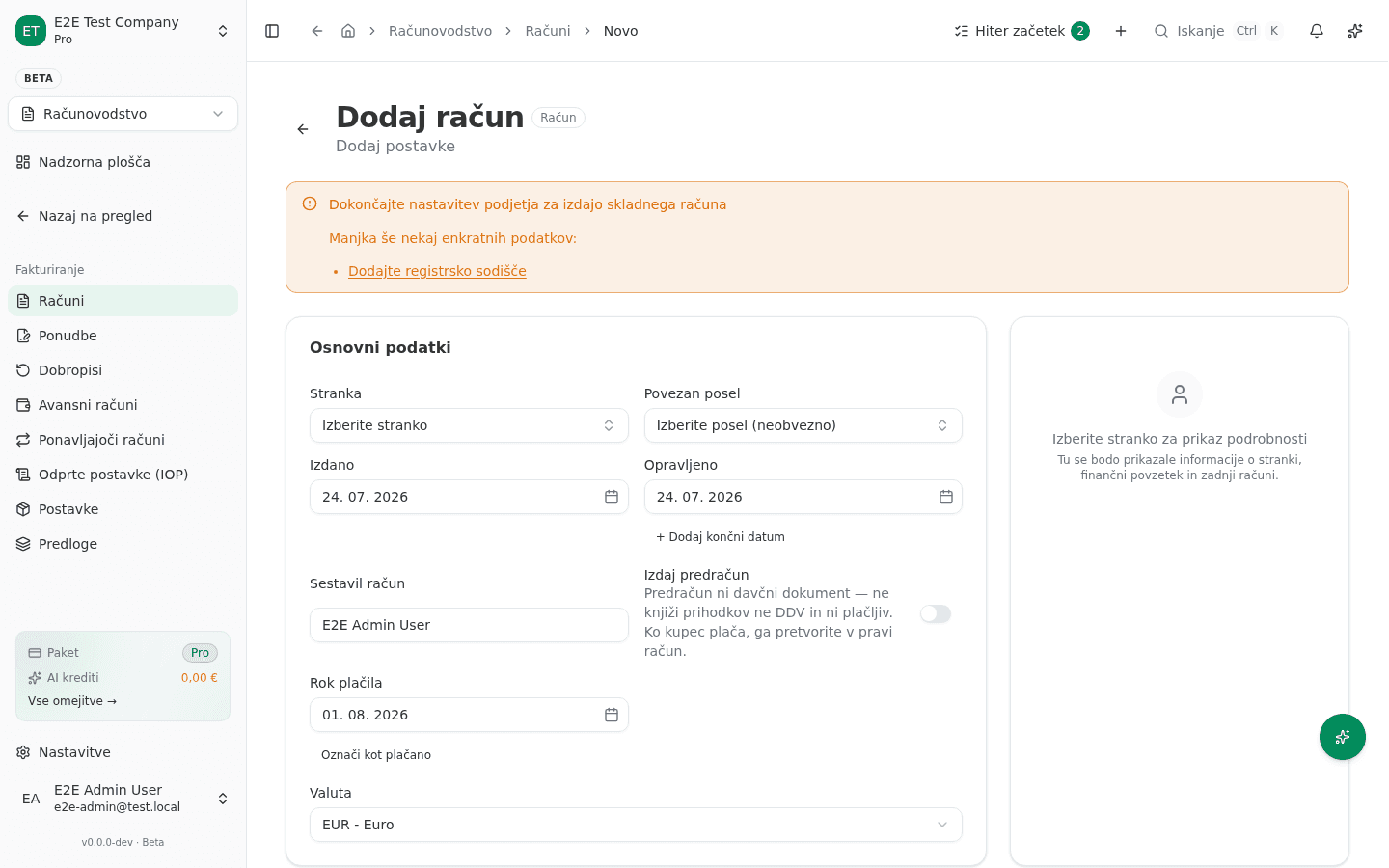
What success looks like
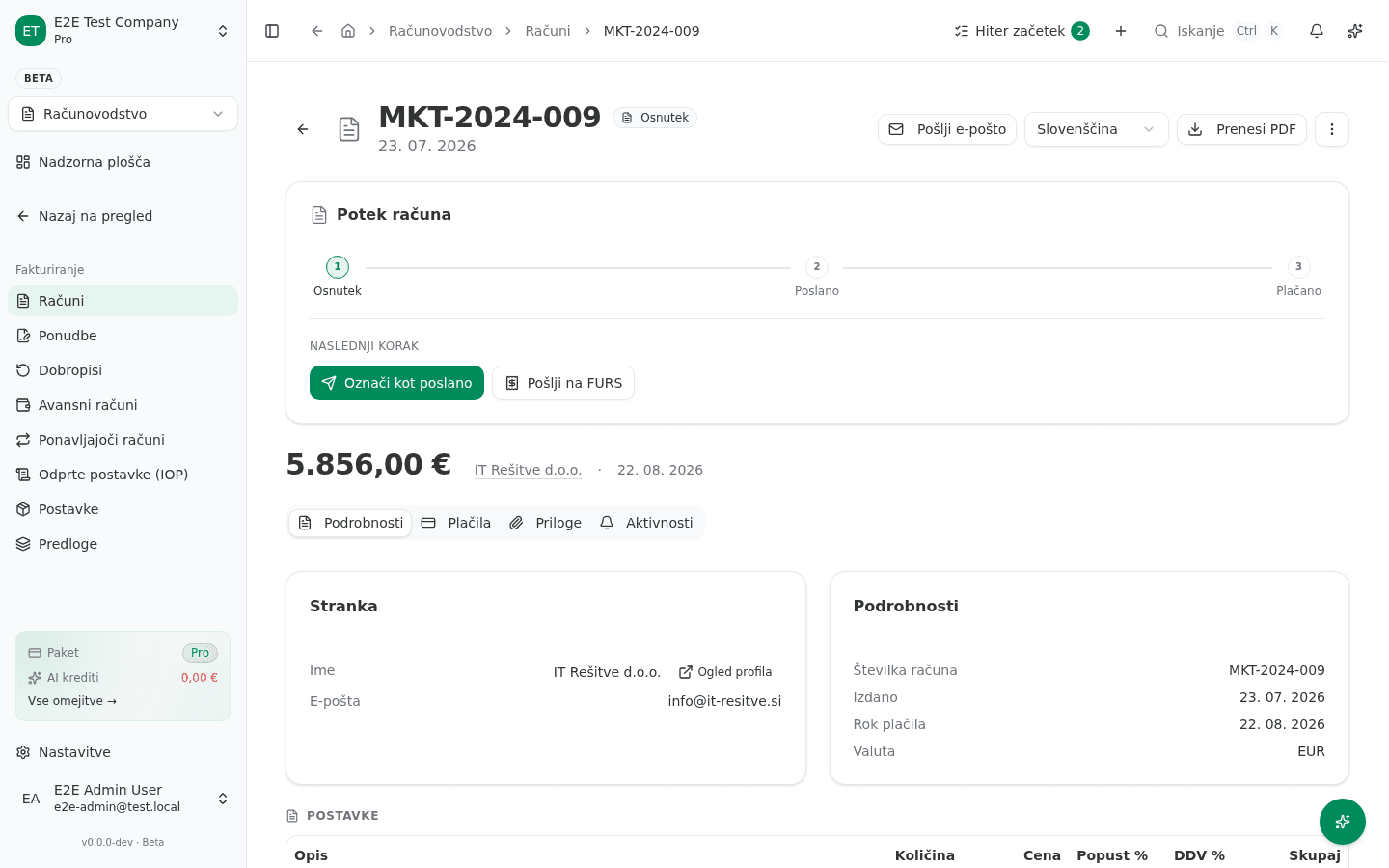
A saved invoice shows Osnutek in the workflow progress at the top of its detail page (Potek računa — “Invoice progress”: Osnutek → Poslano → Plačano). The totals under the line-item table (Znesek brez DDV / DDV / Skupaj — net / VAT / total) recalculate live as you add items.
Quotes and credit notes
Quotes (Ponudbe) can be converted directly into an invoice once accepted. Credit notes (Dobropisi) reference the original invoice they correct — create one from an issued invoice’s Ustvari dobropis (“Create credit note”) action, not from scratch.
Electronic invoicing (e-Račun / eSlog)
Many Slovenian public-sector and larger B2B customers require electronic invoices in the eSlog format, transmitted through UJP (the government’s e-invoice clearing point) for public-sector recipients. VegaERP generates the eSlog XML from the same invoice data you’d use for a regular PDF invoice — you don’t maintain the document twice.
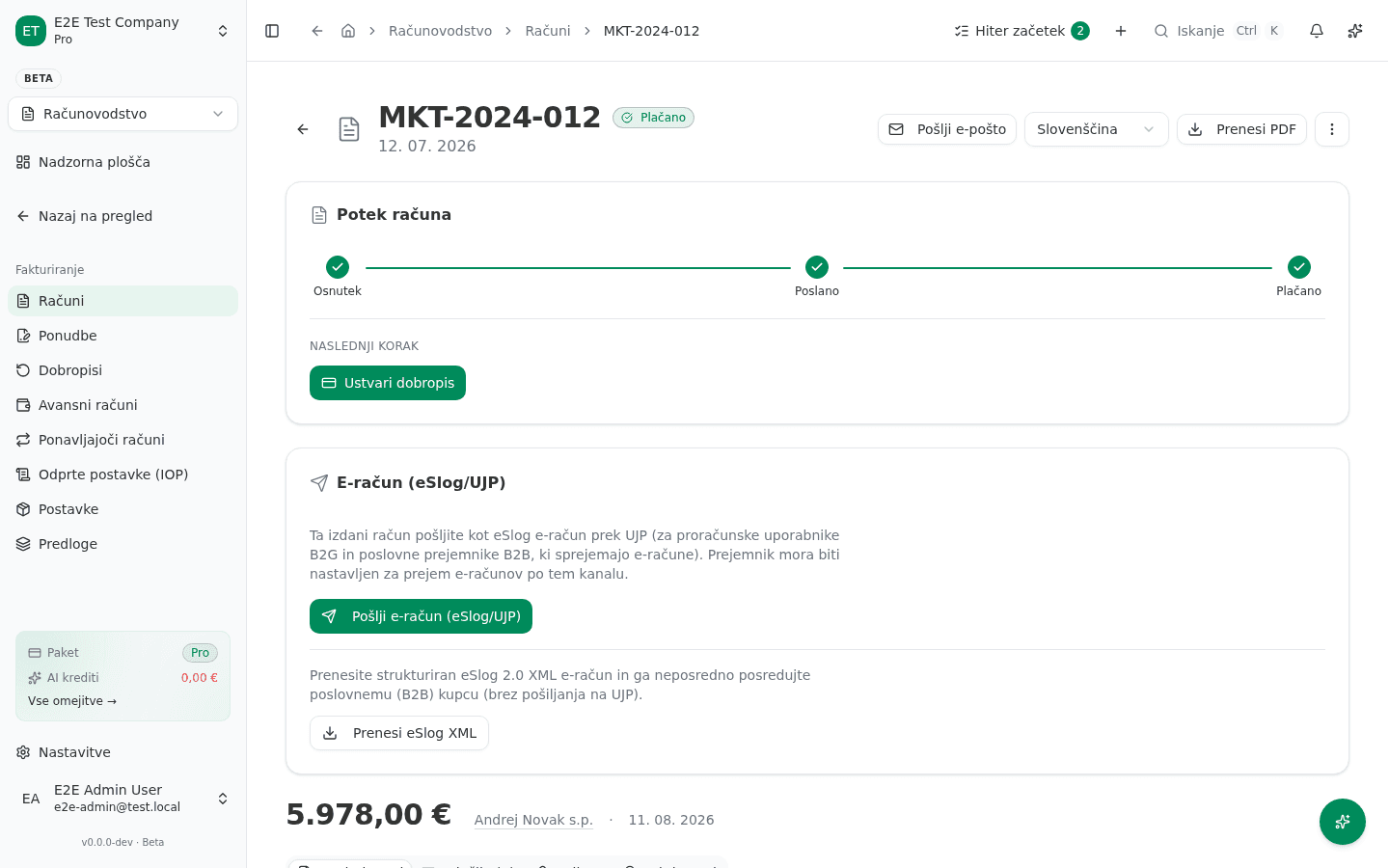
On an issued invoice’s detail page — the panel only appears once the invoice has moved past draft — the E-račun (eSlog/UJP) section offers two separate actions:
- Pošlji e-račun (eSlog/UJP) (“Send e-invoice”) — transmits the invoice to UJP directly. Confirming warns that, once accepted, the e-invoice cannot be cancelled — only corrected with a credit note or a storno.
- Prenesi eSlog XML (“Download eSlog XML”) — downloads the structured eSlog 2.0 XML so you can hand it to a B2B customer directly, without going through UJP.
For B2B recipients on the broader European PEPPOL network, invoices are exchanged through PEPPOL access points using the Slovenian participant identifier scheme, rather than direct UJP transmission.
Fiscal (cash) receipts
If you issue receipts for cash or card payments to consumers (B2C), those go through fiscal verification instead of e-Račun — a draft invoice’s detail page shows a Pošlji na FURS (“Send to FURS”) step for this instead of the eSlog panel above (the two never appear together: one is draft-only, the other only shows once issued).
See Fiscal verification (FURS) for the full flow. E-Račun and eSlog apply to B2B/public-sector invoicing; fiscal verification applies to B2C cash transactions. Don’t confuse the two — they’re separate FURS requirements with different triggers, and the app never asks you to do both for the same invoice.
Common issues
- “Pošlji na FURS” prompts for a certificate instead of sending. Fiscal verification (and DDV-O submission) needs an active FURS certificate uploaded first (Nastavitve → FURS Certifikat). Upload it once; every subsequent send works normally.
- Invoice rejected by UJP or a PEPPOL access point. This is almost always a data problem on the invoice or the recipient’s registered participant details, not a VegaERP bug — check the recipient’s tax number and registered e-invoice identifier are correct before re-sending.
- Wrong VAT on an invoice. Trace back to the contact’s VAT-payer flag and country — see VAT books & the DDV-O form.