Fixing an invoice you already issued
A mistake on an already-issued invoice is common, and in VegaERP it has exactly one correct answer: you don’t edit an issued invoice — you issue a credit note. This page explains when you can still edit, when you can’t, and how to issue the credit note.
First: what state is the invoice in?
| Invoice state | What you can do |
|---|---|
| Osnutek (draft) | Edit or delete it; nothing has been posted yet. |
| Poslano (issued) | The tax-relevant fields are locked. Correct with a dobropis. |
| Plačano (paid) | The editor won’t even open. Correct with a dobropis. |
Draft is the only state in which editing is still editing. Everything else means a new document.
Why an issued invoice can’t be edited
If you open an issued invoice with Uredi (Edit), the form does open — but the fields are greyed out. The reason is stated at the top:
Zaklenjeno — račun je izdan. Kupec, datumi in postavke so bili ob izdaji knjiženi v glavno knjigo in DDV evidenco, zato jih ni več mogoče spreminjati. Za popravek izdajte dobropis (storno) in izstavite nov račun. Rok plačila, opombe in »Sestavil« lahko še vedno urejate.
(Locked — the invoice has been issued. The customer, the dates and the line items were posted to the general ledger and the VAT records when it was issued, so they can no longer be changed. To correct it, issue a credit note (storno) and raise a new invoice. The payment term, the notes and “Prepared by” can still be edited.)
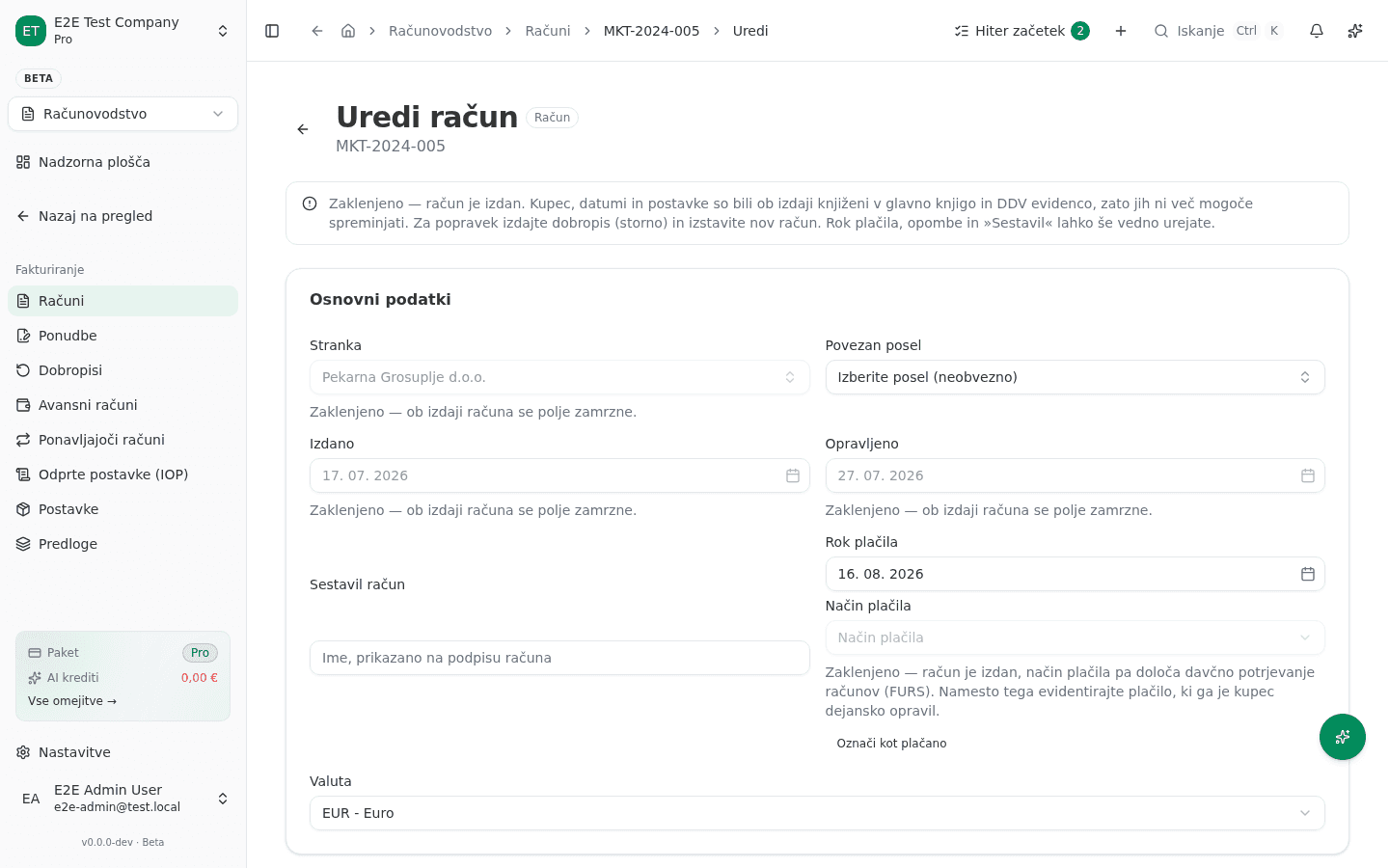
Locked are Stranka (Customer), Izdano (Issued), Opravljeno (Service date), Način plačila (Payment method) and the entire Postavke section (Dodaj postavko and Počisti vse are disabled too). Each field carries its own note: “Zaklenjeno — ob izdaji računa se polje zamrzne.”
Rok plačila (payment term), Opombe (notes) and Sestavil račun (prepared by) stay editable — none of them determines the posting. Povezan posel (linked deal) and Valuta (currency) remain editable too.
The payment method has its own reason
On Način plačila, the app says something different from the other fields:
Zaklenjeno — račun je izdan, način plačila pa določa davčno potrjevanje računov (FURS). Namesto tega evidentirajte plačilo, ki ga je kupec dejansko opravil.
(Locked — the invoice has been issued, and the payment method determines fiscal verification (FURS). Record the payment the customer actually made instead.)
The payment method is what decides whether an invoice goes through fiscal verification. Changing it after the fact would put it out of step with what was — or wasn’t — reported to FURS. If the customer paid differently from what the invoice assumed, record that as a payment: the method belongs on the payment, not on the invoice.
Dobropis and storno — which is which
These are two different words for two different things, and the app uses them consistently:
- A dobropis is the document. That is its name in the menu, in the list and on the buttons: Dobropisi, Nov dobropis, Izdaj dobropis.
- A storno is the effect of that document — the opposite entry that reverses the original. The app mentions it in explanations (“Storno prihodka in obračunanega DDV se knjiži …”).
So what you are looking for is a dobropis; the storno is what it does.
Issuing a credit note
There are two routes, and they are not equivalent. Decide first whether you are reversing the whole invoice or only part of it.
A full credit note — from the invoice
- Open the issued invoice you want to correct (Računovodstvo → Fakturiranje → Računi).
- In Potek računa, under NASLEDNJI KORAK, click Ustvari dobropis (Create credit note). The credit note is created immediately: its page opens in status Osnutek, with the invoice’s line items copied over in full.
- When the draft is right, click Izdaj dobropis under NASLEDNJI KORAK.
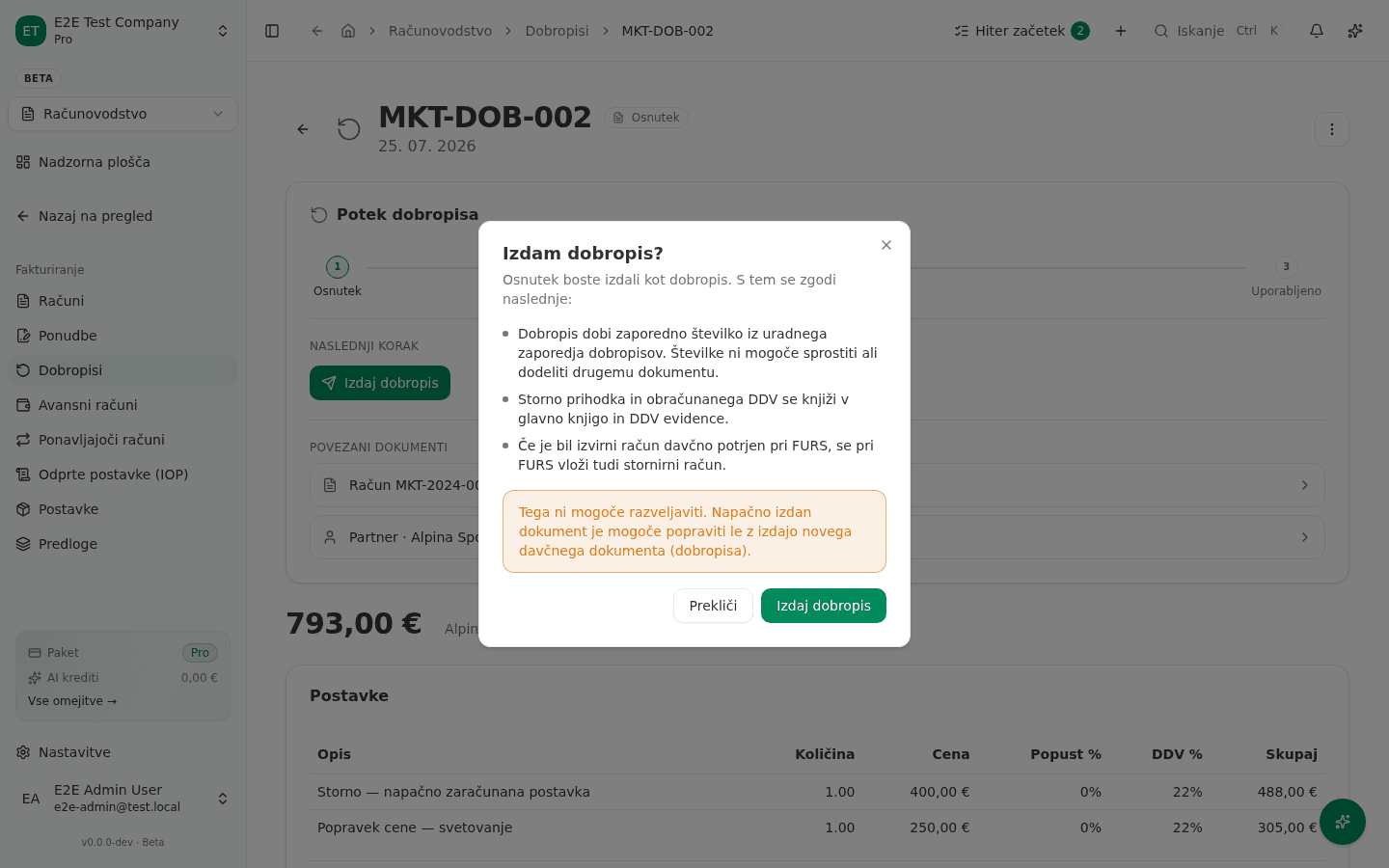
- Read the Izdam dobropis? confirmation dialog, and only then confirm with Izdaj dobropis.
On this route the quantities cannot be changed — not on the credit note’s page and not under Uredi dobropis; the line items are display-only. If you have already taken this route but need a partial credit note, delete the draft and start again via the route below.
A partial credit note — via Nov dobropis
To reverse only part of an invoice, start from the credit notes, not from the invoice:
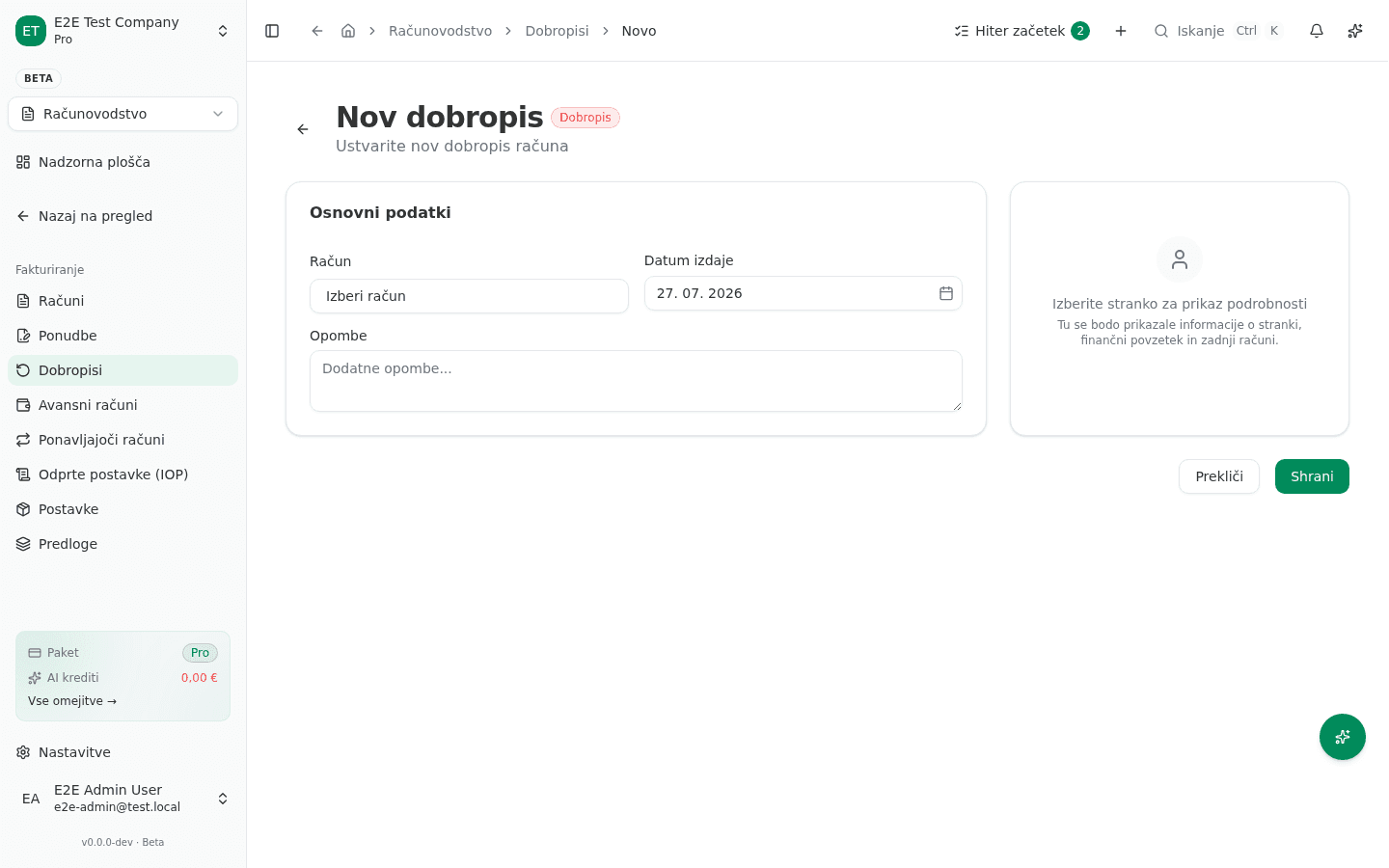
- Open Računovodstvo → Dobropisi and click Nov dobropis (New credit note).
- Click Izberi račun (Select invoice) and pick the invoice in the Izberi račun dialog.
- A Postavke (kopirane iz računa) section appears — line items copied from the invoice, with editable quantities and this hint: “Prilagodite količine za delni dobropis. Nastavite na 0, da izključite postavko.” (adjust the quantities for a partial credit note; set one to 0 to exclude that line). Adjust the quantities and fill in Opombe if needed.
- Click Shrani, then Izdaj dobropis on the credit note, and confirm.
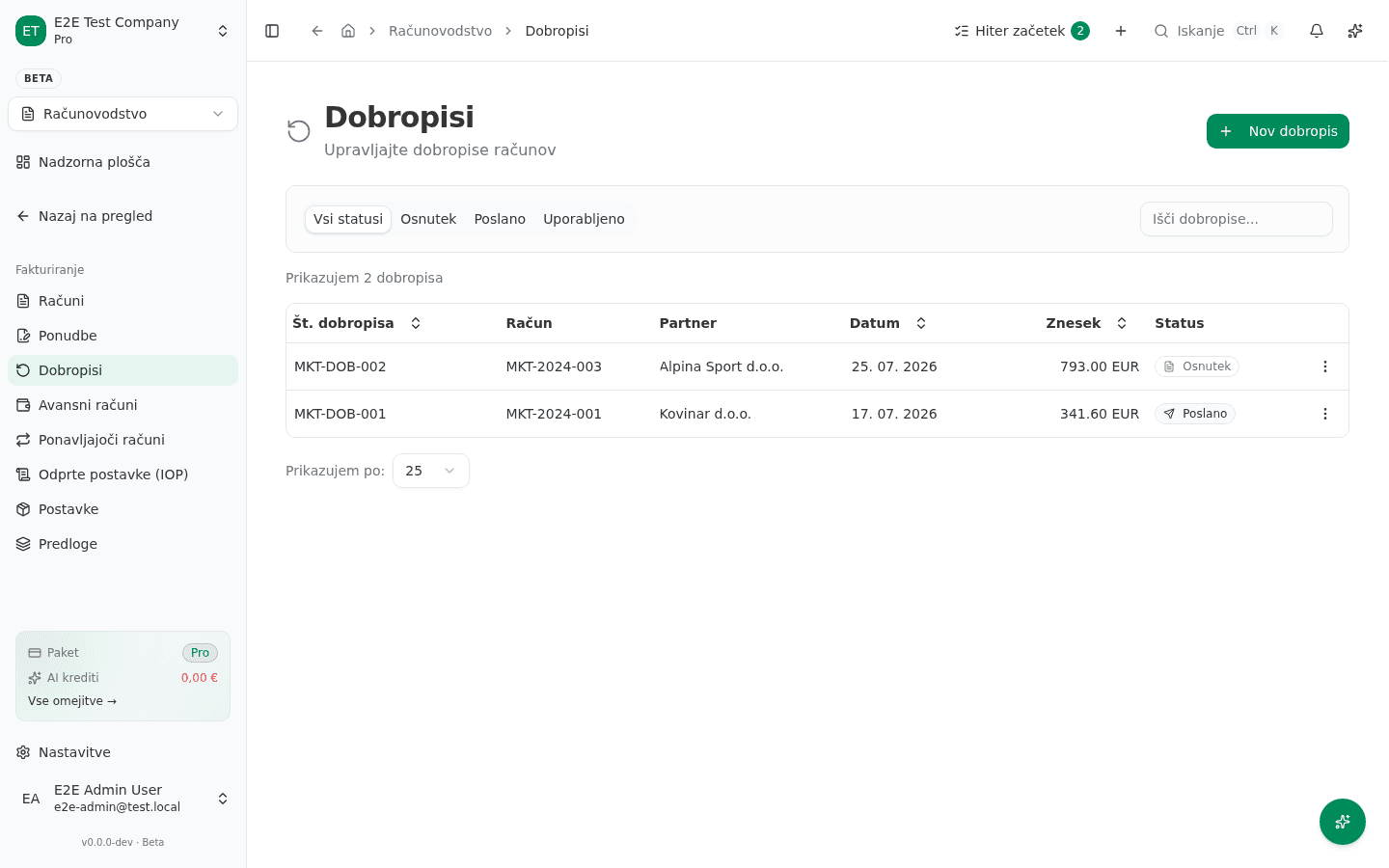
The Dobropisi list has Št. dobropisa, Račun, Partner, Datum, Znesek and Status columns, and the tabs filter by status (Vsi statusi, Osnutek, Poslano, Uporabljeno).
Read the confirmation — this cannot be undone
Before the credit note is issued, the app spells out exactly what will happen:
Izdam dobropis? Osnutek boste izdali kot dobropis. S tem se zgodi naslednje:
- Dobropis dobi zaporedno številko iz uradnega zaporedja dobropisov. Številke ni mogoče sprostiti ali dodeliti drugemu dokumentu.
- Storno prihodka in obračunanega DDV se knjiži v glavno knjigo in DDV evidence.
- Če je bil izvirni račun davčno potrjen pri FURS, se pri FURS vloži tudi stornirni račun.
Tega ni mogoče razveljaviti.
In English: the credit note takes a number from the official credit-note sequence and that number can never be released or reassigned; the reversal of the revenue and the charged VAT is posted to the general ledger and the VAT records; and if the original invoice was fiscally verified with FURS, a storno receipt is filed with FURS too. None of it can be undone.
Hence one simple rule: press Izdaj dobropis exactly once. If the page doesn’t look like it changed, refresh it and check the state — do not click again. Issuing twice would file a second storno with FURS, and that cannot be recalled. The app will say so if you try:
Ta dobropis je bil z drugim dejanjem že izdan (ali izbrisan), zato ga ni mogoče izdati znova — dvojna izdaja bi pri FURS vložila drugi storno, česar ni mogoče razveljaviti.
What success looks like
The credit note gets its number and moves in Potek dobropisa from Osnutek to Poslano (the spine is Osnutek → Poslano → Uporabljeno). On the original invoice, a Dobropis {number} row appears under POVEZANI DOKUMENTI with the amount and a Dobropisano marker; on the credit note you get Račun {number}. From then on the two documents are linked in both directions.
You then don’t correct the original invoice at all: you raise a new invoice with the right details.
A cash invoice verified with FURS
An invoice that went through fiscal verification has a permanent record at FURS (its ZOI and EOR). Cancelling it in the app does not erase that record, so cancelling isn’t offered at all — you get this instead:
Tega računa ni mogoče preklicati, ker je bil davčno potrjen pri FURS in bi tam ostal potrjen tudi po preklicu. Namesto tega izdajte dobropis (storno), ki pri FURS vloži stornirni račun.
(This invoice cannot be cancelled, because it was fiscally verified with FURS and would remain verified there even after cancellation. Issue a credit note (storno) instead, which files a storno receipt with FURS.)
For such an invoice the credit note is the only route — which is exactly why it matters that you issue it once.
The same applies to supplier invoices
A supplier invoice that has already been posted is not deleted either. When you confirm the deletion you get a Ta račun je že vknjižen dialog with a Storniraj račun button. The full walkthrough is in Booking supplier invoices.
Common problems
- The invoice can’t be deleted. An issued invoice is posted to your books; the app refuses the deletion and points you to a credit note.
- Cancelling is refused because payments are recorded. Reverse the payments first, or issue a credit note.
- The invoice changed in the meantime. If the page has been open a while, the document may already have been issued, cancelled or deleted in another tab. Refresh and check the state before repeating the action.
- A credit note isn’t possible because the invoice isn’t issued. Credit notes only apply to sent or paid invoices; drafts and proformas can’t be reversed with one — simply edit or delete the draft.
- A credit note can’t be edited after it’s issued. Only credit notes in draft status are editable.